Category: Marketing
Sports Marketing
I’m currently taking a sports marketing class, so this post will be updated occasionally throughout the next several weeks. Some of the information below is really more of general marketing, but the content below has been mentioned and noted for this class and topic specifically.
Update – 11/14/13

Greg Hill, former NFL running back
Today’s class featured two guest speakers: Steve Riddle of Nike and Greg Hill, former NFL running back. Steve worked as an NBA agent, and his primary message was that relationships, trust, and integrity are the most important things for an agent to have. “Relationships are paramount.” He said that there isn’t much to getting certified as an agent. You have to fill out an “extensive application and background check” and you have to already have a player to represent.
Greg Hill was very interesting. Great speaker. He said he’d only lost 5 games in his whole football career before entering the NFL. He’d been playing football since he was 8 years old. He said he has “24 hour headaches” and every part of his body hurts. He has to sleep sitting up. He’s had 17 concussions. He stops at stop signs and waits for them to turn green. He has temporarily forgotten his son’s name, which is the same as his own. He doesn’t let his son play football.
Hill said there is hazing in the NFL and had several stories about that, including having to buy the offensive line’s meals as a rookie on a team trip to Japan. If he had to choose between Richie Incognito and Johnathan Martin as a teammate, he chooses Incognito. “You want the guy with one foot in jail already. The guy half-stabbing someone. Someone who can go down a dark alley with you,” he said somewhat jokingly.
Reading highlights:

Phil Knight of Nike
- “A brand is something that has a clear-cut identity among consumers, which a company creates by sending out a clear, consistent message over a period of years until it achieves a critical mass of marketing. The thing is, once you hit the critical mass, you can’t push it much further, and before long, the brand is on the way out.” – 1992 Harvard Business Review interview with Nike founder, Phil Knight.
- Segment for success. Nike had the running shoe market, but sales were slumping, so they created the Air Jordan to get the basketball market. Then created two other styles for players who had a different style of play than MJ.
- Sports marketers have to address the needs of sports participants, encourage their passion
- On sponsorships: “Part of the problem is that some clients and agencies think that the sport they align with will do the marketing job by itself. In reality, to be effective at sports marketing requires the same attention to detail as any other discipline.”
- For the Visa Olympic sponsorship: To get the most out of the sponsorship, they have to spend between $300-$400 on marketing for every dollar spent on the sponsorship. NOT including the media buy! However, the “golden rule” for sponsorship support is $2 of advertising for every $1 of sponsorship.
Vision and Mission:
A vision should be a long-term road map for the company. It should answer/address four key questions:
- Where does the organization to plan to go from here?
- What business do we want to be in?
- What customer need do we want to satisfy?
- What capabilities are required for the future?
A mission statement should address a group of slightly different questions:
- What business are we in now?
- Who are our current customers?
- What is the scope of our market?
- How are we currently meeting the needs of our customers?
Example Mission Statement from New Balance:
To be the world’s leading manufacturer of high performance athletic and active lifestyle products while operating in a socially responsible manner.
Digital Marketing
I’m going to start with Digital Marketing because I just finished this class, and it’s fresh on my mind. Of course, digital marketing is my area of expertise, so it was mostly refreshers, but below are some notes nonetheless.
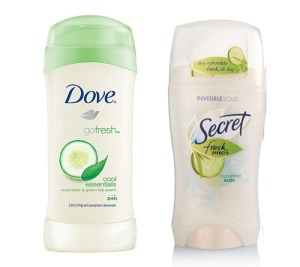
Draft & win strategy – This strategy is basically to copy a competitor that is doing well. An example is Secret deodorant. When Dove started making a strong push, Secret (the market leader with the most shelf space in store) designed a product line that looked very similar to Dove’s line. The point is to confuse the customer into thinking they are buying the competitor’s product. The comparison image on the right shows the similarities in colors, the word “fresh”, and the cucumber and leaf design.
Branding & position – Purpose exists from the beginning. Position is for gaining market share, can be more campaign-oriented. The “why” doesn’t change over the years, but the “what” will. Who the company is doesn’t change as often as the tactics. There is a Ted Talk on this topic that our guest speaker referenced.
Digital strategy phases:
- Discovery – What is the business imperative? Define and detail customer experience. Market analysis.
- Visioning – Where do we want to go in the future? Create a roadmap.
- Planning – How to translate the roadmap. Make sure each tactic or project fits with overall strategy.
Ad agenecy CEO on employees:
- Customers, prospects, employees – all are equal
- There is a real cost to having disengaged employees
- It is “disastrous” to lose an “A” employee
- Estimated cost of losing a good employee: 3x employee’s salary
Random tidbits:
- In 2012, roughly 35% of Secret’s marketing budget was digital.
- It takes roughly 7 marketing “touches” to make someone remember your company.
- Test creative – change one element in each ad version. Have a control version.
- Before analyzing data, ask yourself, “What do we want to know? What are we going to do with the data? How are we going to improve our marketing strategy with the data?”
- When there is a land grab to get market share, spend up to 80% of revenue on marketing.
- Telligent is a Microsoft social networking system that allows white labeling
- Tagboard collects social/tagged photos into one place
- Linking to or being linked to from .edu/education sites, builds SEO
 NotesFromAnMBA